On Perspectives 6 June 2025
Section One: Using the analogy of a four way intersection
Have you ever noticed how different an intersection looks when arriving at it from a new direction, particularly one you seldom or never use from another direction? Or if you hike, how different a given section of the trail looks going out (outbound) and coming back (returning).
For example, if you are usually headed South to North on a road coming into an intersection, you are used to looking down the road to the path your car is taking. You are in a frame of reference (a channel) created from your direction of travel.
Now let us say you arrive at this intersection 90 degrees out headed West to East, an entirely new direction of arrival. You are not use to seeing this intersection from this angle, this perspective. It is like being in a foreign land, you initially do not recognize it. Only after reading the street signs at the intersection do you sense the entire newness of the place you are at and how different it looks. You do not recognize it, but yes, this is the intersection you are familiar with from another perspective (direction, frame of reference).
And I thought about this experience in the context of when we are talking with people about the intersection of an idea (current affairs, business strategies etc.). We often have a different perspective on the idea/concept being discussed then that of the other’s perspective. The other person’s perspective is not easily recognized by us. We have trouble shifting our perspective and understanding it and that does not make their perspective any less real (and potentially contributory). And in part, this accounts for the challenge to understand another’s perspective, we are arriving at it from a different viewing direction. We have become habituated to arriving at the intersection (the subject) from one perspective, and are biased to it.
Going back to the metaphor of the road intersection. The intersection is still the intersection (the context is still the context). You are just perceiving the intersection (the context) from different perspectives. And that’s why you need to talk about it (your differing perspectives) to try and figure out where you might overlap and where the differences are. Importantly one should strive not to question the validity of the other’s perspective. Indeed, that would be kind of silly, because it is valid from their perspective (their arrival of direction to the context), even as yours is valid from the direction you arrived (your perspective). Well, there you have it, just a little analogy to help understand discussing perspectives with others being likened to arriving at a given intersection from different directions. The important point is you are looking at the same context (the intersection is the intersection) and the variance is perspective.
What might one learn if they relax being dogmatic on their perspective and venture over to the other point of view? It could well expand their overall appreciation of the context. And expand their views to the context. By adding perspectives to a given context being discussed there is the potential to gain a much richer view of the whole context. To see the problem, the issue in multiple perspectives, and while challenging it holds the potential of gaining insight and seeing the issue in a whole new light of perspective.
Other notes, habituation of your direction of arrival is a big part of this challenge to assume another viewpoint. That accounts for the belief we bring into the intersection. The frame of reference we bring to the idea we are discussing. And we enter many discussions on a given subject with what is called confirmation bias (whereby we are motivated to confirm our point of view).
And I do not mean to say it is all relative, that is, that not all perspectives contribute to the context. That decision can only be made by all the parties to the discussion, who must determine relevance and value of the perspectives being offered.
Section Two: Using the analogy of a hiking trail.
In this analogy we are going to use a hiking trail, the outbound and return bound perspective for a given area of the trail. It is a simpler analogy (then that of a car intersection), now there are just two perspectives of the same setting, subject, context, instead of the four perspectives at a typical intersection as previously discussed.
So, putting the intersection analogy aside for now, let us look at another analogy. That of an individual hiking a trail in the mountains. I have picked a section on the trail when I was headed outbound that I did not recognize when coming back on the trail. It is the same place, but seen from the perspectives of going out and coming back it was very different. I thought this was a simpler example to illustrate how the shift in perspective, can be challenging to recognize the context. And if I was arguing with my going out self and my coming back self on how that section of the trail looks, could we work through the differing perspectives to arrive at an agreement on some fundamental facts about that section of the trail.
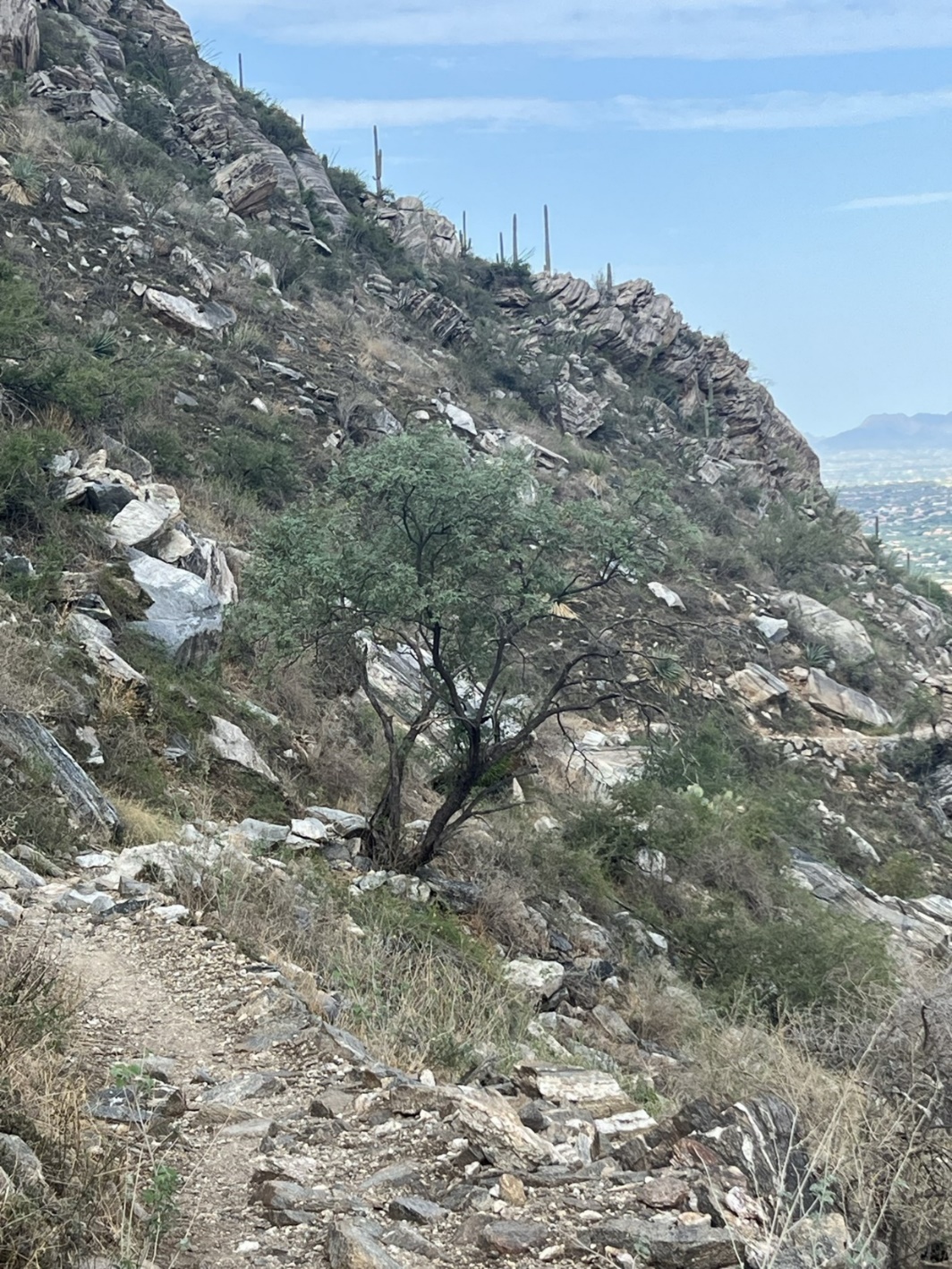
Hiking outbound (North) on the Phoneline Trail
The blue triangle symbol denotes the place from which the oppositive direction photo was taken.
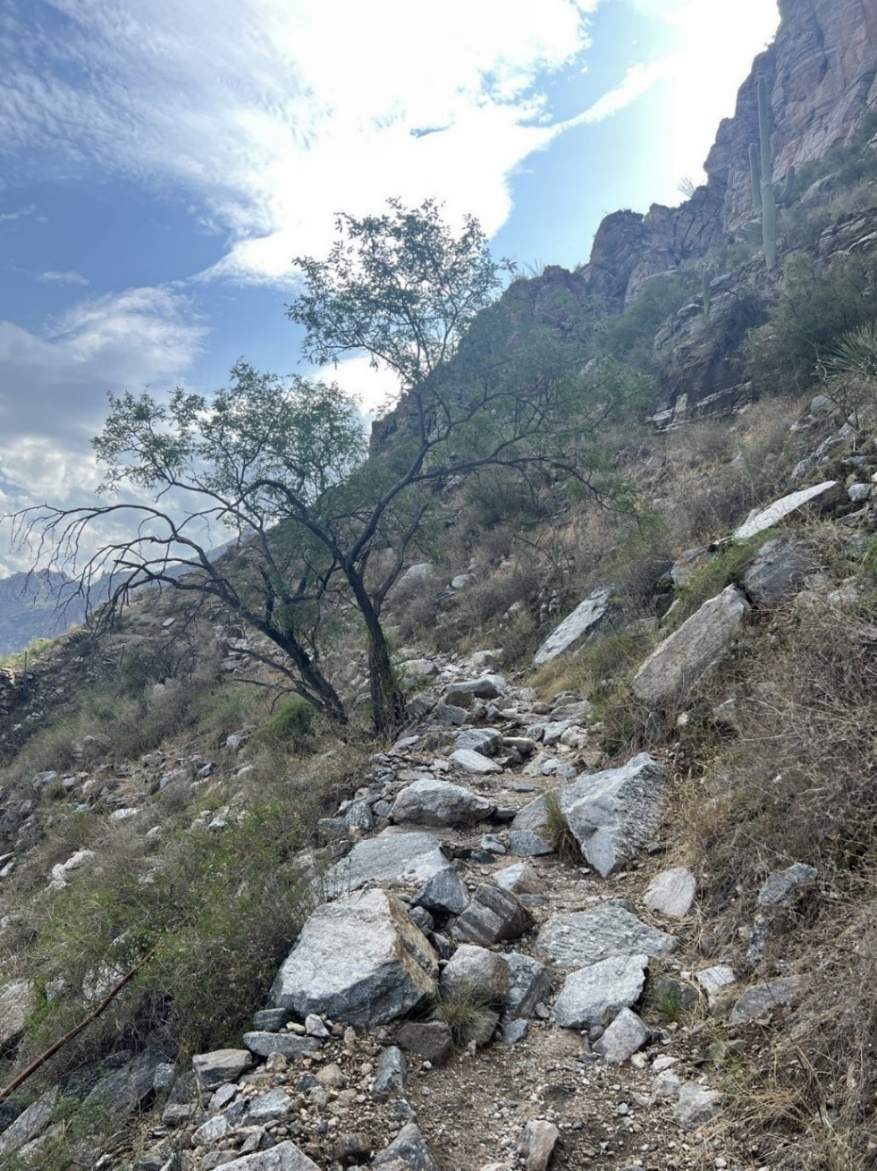
Hiking on the return (South) on the Phoneline Trail
The blue triangle symbol denotes the place from which the opposite direction photo was taken. The outbound leg of the hike.
So, what can we say about these two photos. From experience walking this trail I can say it appears as two different places. The perspectives are unique unto themselves.
The Outbound Direction (North): You are headed uphill; the hill is sloping steeply down to the left. The principal landmark is the tree which appears to be draping over the trail and is dominant in the scene (dead ahead).
The Returning Direction (South): You are headed downhill, now the upper slope of the hill seems steeper. The ridgeline is closer. The tree is not as dominant and does not appear to be draping over the trail but to be tilting down the slope. And you are looking at the hills of Tucson, not the outbound Catalina Mountains.
This is only two different perspectives of a single context of the trail, the tree section. And yet it is not that simple, if the tree is the point of the discussion of the context, you are likely to disagree about its orientation and appearance on the trail. Your perspectives, your ideas on the subject will be different.
Remember you do not have the advantage of having these two photos in front of you to compare and work through the idiosyncrasies of your perspectives.
But, after your initial effort to establish your perspective and there is still push back. Do not automatically reload and come right back with more data and evidence. Instead adopt curiosity and ask questions about their perspective. Such as what direction, their orientation to the context are they speaking from? In this case you might discover they are looking at it from the opposite direction. Ask them which way the slope of the hill falls away from the tree, to the left or the right? Are they headed uphill or downhill?
Over time, like the blind men looking at the elephant you might well discover both the differences in your perspectives and the similarities as well.
Seen from above, in a kind of God’s eye view of the trail, the trail is the trail and the tree is the tree. They are fixed in time and space, you are the variance in your views, your unique perspectives. You can with effort get to a mutual set of beliefs and references to the context, the trail, and the tree if you stay open minded and seek to understand the other’s perspective.
Editorial:
If I am honest, I am uniquely unqualified in a sense to discuss perspectives, because I was a very opinionated person most of my life and took strong counsel in my own perspective. I was in short not curious, nor particularly interested in other perspectives. Why should I be, I knew the right answers.
I was the individual who you would least like to discuss a contentious issue with, because I am not likely to listen and I entered the conversation with a big fat confirmation bias. That is, I am mostly listening to confirm my opinion.
But there were problems that arose with this behavior, and it took some hard-headed women in my life and some courageous colleagues to bring my attention to it. I say attention, but these were initially bewildering experiences for me, the whole suggestion that I could be wrong and close minded, put me in a spin. And at least initially only made me double down on my evidence and arguments to carry my belief to the context.
However, there was something unsettling enough in this push back to cause me begin to re-enter the human race and come down off my throne of opinions. That essentially was the revelation that I could be wrong, that I can be passionate and convicted and dead wrong!
A story, I oversaw a large effort in the Air Force and was the initial lead for 6th Gen Fighter, the replacement for the F-22. I had two individuals both fighter pilots out of light grays dedicated to the effort working with me. One of them was like me in demeanor – sure of himself, aggressive and use to being right. A planning issue came up and dealt with the way we were assessing the value of key attributes to future air superiority. We did not agree, we argued and it was very intense. I was initially able to carry the argument by using rank and saying, “well I am just not buying it.”
But, “Shotgun” was not having it, and he would not go away, he would daily reengage me in the argument. He felt very strongly about it. And something happened after this 2nd engagement. We settled nothing, but I came away very shaken internally. I highly respected Shotgun; he was highly qualified in every aspect of weapons and tactics and frankly logic. So, I asked myself, what if you are wrong, what are you not understanding?
So, when next we met, I was committed to shutting up on my perspective and going all in to understand his. And it was not simple; I had so much bias it was hard to let go of my perspective. And Shotgun was increasingly frustrated with me, but hung with me trying multiple different tacks to help me shift and see his perspective. And then I did, I did see it, and I was wrong, and I was embarrassed to have caused all this unnecessary conflict. The key was getting to our assumptions, I discovered I had assumptions that were not valid and did not fit, and they skewed my view to all the rest of the context.
After this encounter, I was more reflective entering discussions / arguments, because I had experienced the value of assuming some humility in your view, your perspective to a context. I learned to take the time not only to convey my perspective, but really make an effort to understand the other perspectives as well.
There is an old saying, “where you stand depends on where you sit.” It’s called Miles Law and is attributed to Rufus Miles of Princeton University back in the 70’s. The point is that one’s perspective is always shaped by their environment.
Where you sit on a given context determines your perspective to it, and that in turn directs your argument, your stand on the topic. This is inevitable, and will determine your initial orientation, but if you are willing to suspend your perspective, and make the effort to shift your seat and look at the context from a different perspective, you might better understand their stand. And thereby reach the promised land of a reasoned debate and an arbitrated position that is ageable to both parties.